QTC™ Material Technology
Pressure sensitive control and electrical switching
Pressure-sensing and Switching
The potential for the QTC™ Material to transition from an insulator to a conductor (i.e. change its electrical property) is influenced by how much deformation the material is experiencing as a result of the applied mechanical pressure.
QTC™ Material can be used to produce low profile, low cost, pressure activated switches or sensors that display variable resistance with applied force and return to a quiescent state when the force is removed. The difference between a QTC™ Material switch and a QTC™ Material sensor is arguably only the speed and amount of physical input required to achieve the required switching point or resistance range.
Open circuit: Rest state > QTC™ Material insulating. In unstressed state, QTC™ Material behaves as an insulator (R>1012 Ω). |
Closed circuit: Compressed state > QTC™ Material conducting. Under compression, tension or torsion the resistance drops gradually and controllably. QTC™ Material can be capable of passing high currents. |
Switching Performance
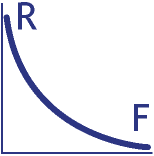
Force (N) and Resistance (Ω). The graph shows the effect of varying the current at constant voltage.
The transition from insulator to conductor follows a smooth and repeatable curve, with the resistance dropping exponentially.
In theory, the resistance of QTC™ Material decreases exponentially with compression – subsequently, allowing increasing current flow through the material. In practice uniform compression is rarely achieved and therefore the resistance change with compression will deviate from a true exponential.